By Cara Baldwin, Chief Legal Officer and Head of Product Operations
My first real job was as a scientist. Not a lawyer, not an operations person. A scientist. I was the kid who wanted to know how ants organized themselves, what friction actually was, how trees moved water. I just liked knowing how things worked.
Then, through a series of events I won't bore you with, I went to law school. And somewhere in there I learned something that took a while to fully land: the laws of nature are non-negotiable. The laws we write down? We made those up. Every single one of them.
That distinction is basically my entire job.
New technology, old rulebooks
When Nate first started talking to me about Torus, I had just started a new job, but the company he was building was just too interesting to forget. When I finally joined full-time two years ago, the job was simple enough to describe: help a new kind of energy technology move through a world that wasn't built with it in mind.
What I found is that the biggest obstacle isn't the technology itself. It's the person sitting in a city planning department who's approved every building in that city for the last 27 years or a utility interconnection team built to handle large-scale generation projects. They're not your adversary, but they've never seen what you're building, and when people haven't seen something before, there are a lot of ways to slow it down. And they'll find them, not out of malice, but because they need to understand the project and the solution.
The instinct for some is to push through that. Most companies needing a permit have a bias for action. I've got that instinct too. But in a regulated space, there are many ways to block a project unintentionally. Being mindful about how you navigate the regulatory process matters more than moving fast.
The most effective regulatory strategy runs in two parallel paths, and what works is often counterintuitive. The instinct is to ask for something new. However, the first strategy that lands with the building and zoning teams is to use their current framework to secure the permits needed to solve a problem that municipalities grapple with every day. You show them how what you're doing already fits within what they know. What code section applies? What's the precedent? You're not asking for an exception. You're doing the work alongside them, inside the same four walls they've always worked in.
The other path shows how what you're doing fixes a problem they're mandated to fix but don't see a clear path to resolution. You’re working with them to fix an already agreed-upon problem together. You’re filling a gap in their own mandate, not asking for an exception to it.
That's where the legal training actually earns its keep. My best argument is never to ask you to do something new. It's to show you, using what you already know, why what we want is acceptable. You're not blazing a new trail. You're just showing them you already fit on the one they have. But you have to be brave enough to have that conversation. You have to be willing to say, I don't think we should be applying for a conditional use permit here. I know that rule exists, I understand it, but we don't actually fit in that box. Don't put us in it.
The through line from city to city
The federal framework is actually your friend, and I didn't expect that. Energy is regulated at the federal level and that drives local policy, and because of that, the core framework is largely consistent from one jurisdiction to the next. Electric code, interconnection, building codes, about 85 percent of the issues you'll face are going to look the same whether you're in Salt Lake City, Seattle, or Savannah. The edges vary. The personalities vary. But the underlying logic holds. That’s in large part because the underlying principles, the foundational laws of nature around electricity, around what is safe and what is not, are the same everywhere.
What worked in Utah, we used in Oregon. Same argument, same logic. You don't start over every time.
We've taken our installation timeline from over five months down to three and a half and it's still trending down. That didn't happen because we found shortcuts.
The part that made it personal
My husband's a machinist. He teaches high school now but he's spent his career around machine shops, and for years I've heard about what happens when the power goes out. What it costs. What it ruins. The million dollar machine running thousands of dollars of material that gets scrapped because of a momentary outage.
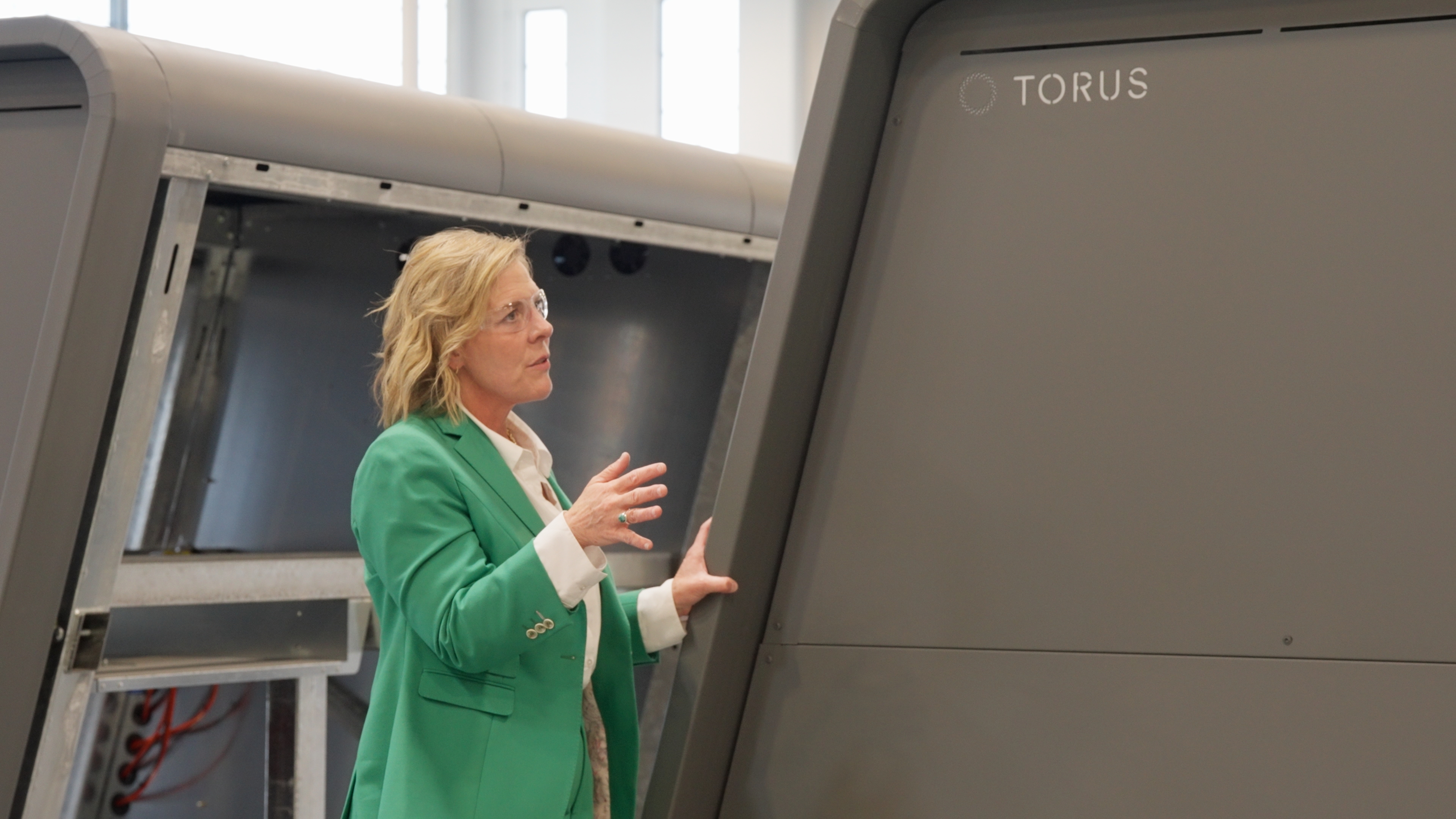
Two of my favorite Torus installations are at shops he works with. Walking our GigaOne floor, watching systems come off the line that I know are going to land at machine shops that are building important products and parts that we encounter every day but we don’t even think about, like a tiny component inside a medical device. These are shops that he's worked with for years, shops where his former students work, I think about that every time. I was watching a problem I'd understood for years, from my husband's world, get solved in a way I actually got to be part of.
And the reason it matters right now is that your grandmother's talking about data centers and power bills. That's where we are. For a kid who just wanted to know how everything worked, it doesn't get cooler than this.